What AERB Approval Actually Means When You're Buying an X-Ray Machine in India
What AERB Approval Actually Means When You're Buying an X-Ray Machine in India
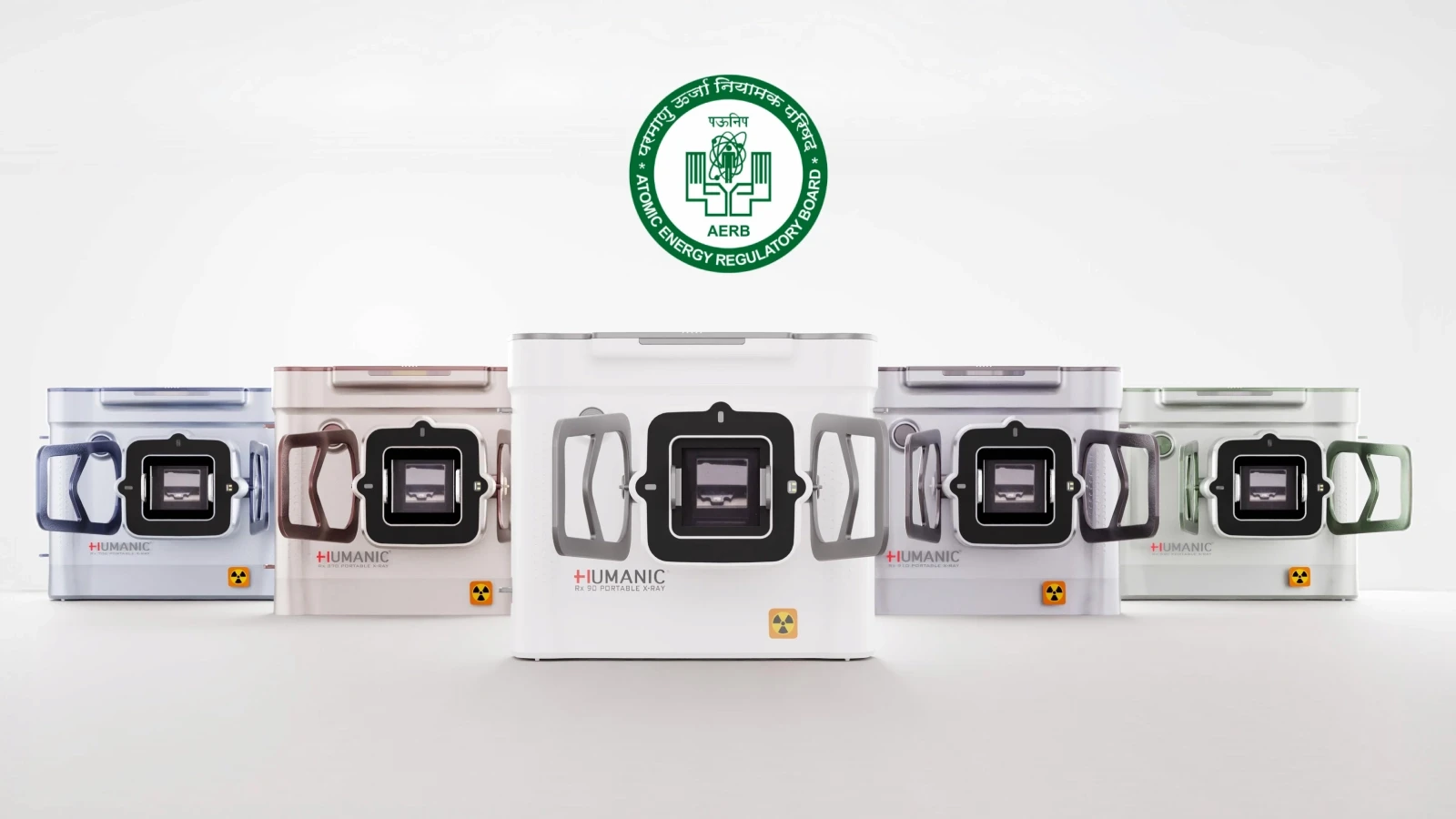
If you're procuring X-ray equipment for a hospital, a government health programme, or a field deployment, there's one certification you need to check before anything else. Not image resolution specs. Not the price. Not whether the supplier mentions CE marking or FDA clearance.
AERB first. Everything else second.
Here's what it actually means, what it does and doesn't tell you, and how to verify it properly.
What Is AERB?
The Atomic Energy Regulatory Board is India's statutory authority for radiation-emitting equipment. It operates under the Atomic Energy Act of 1962, and can set safety standards, grant approvals, and revoke them when equipment fails to comply.
Any X-ray machine used in India, a private hospital, a government PHC, a mobile health van, or a field camp needs AERB type approval before it can be legally switched on. That applies to systems made in India and to systems imported from the US or Europe.
This is where procurement teams sometimes get tripped up: a CE mark from the EU does not substitute for AERB. Neither does FDA clearance. These are country-specific approvals for their own markets. India runs its own evaluation process independently.
What AERB Actually Evaluates
AERB's type approval process isn't a formality. The board evaluates several things that matter directly in clinical use.
Radiation output and leakage. How much radiation the tube emits, and whether it stays within safe limits during normal operation.
Beam quality and filtration. The energy spectrum of the X-ray beam affects both image quality and how much radiation the patient receives per exposure. It's not just a safety metric; it's a diagnostic one.
Exposure control and reproducibility. Whether the machine consistently delivers the set exposure or varies between shots. A device that can't reproduce its settings reliably is a clinical problem, not just a technical one.
Electrical safety. Protection against shock hazards for the operator and patient.
Mechanical stability. Whether the device holds its position during exposure without drifting or shifting.
Labelling and documentation. Whether the device carries required warning labels and comes with user documentation adequate for safe operation.
A device that passes all of this receives a type approval certificate. The certificate number can be verified on the AERB website at aerb.gov.in.
How to Verify an AERB Certificate Properly
Asking a supplier for their certificate isn't enough on its own. Certificates can be outdated, apply to a different model from the same product range, or in rare cases be presented in a misleading way. The correct process takes about 15 minutes.
Ask the supplier for their AERB type approval certificate number.
Go to aerb.gov.in and search the certificate in the equipment registry.
Confirm the certificate covers the exact model being quoted not a related or similar variant.
Check the certificate expiry date. Approvals require periodic renewal.
For government tender submissions, request a notarised copy of the certificate for your tender file.
Step 3 is the one most frequently skipped. A manufacturer may legitimately hold AERB approval for one model in a product line but quote a different model that hasn't yet completed the process. The certificate number lookup on the AERB portal will surface this immediately.
AERB vs Other Certifications — What Each One Actually Means
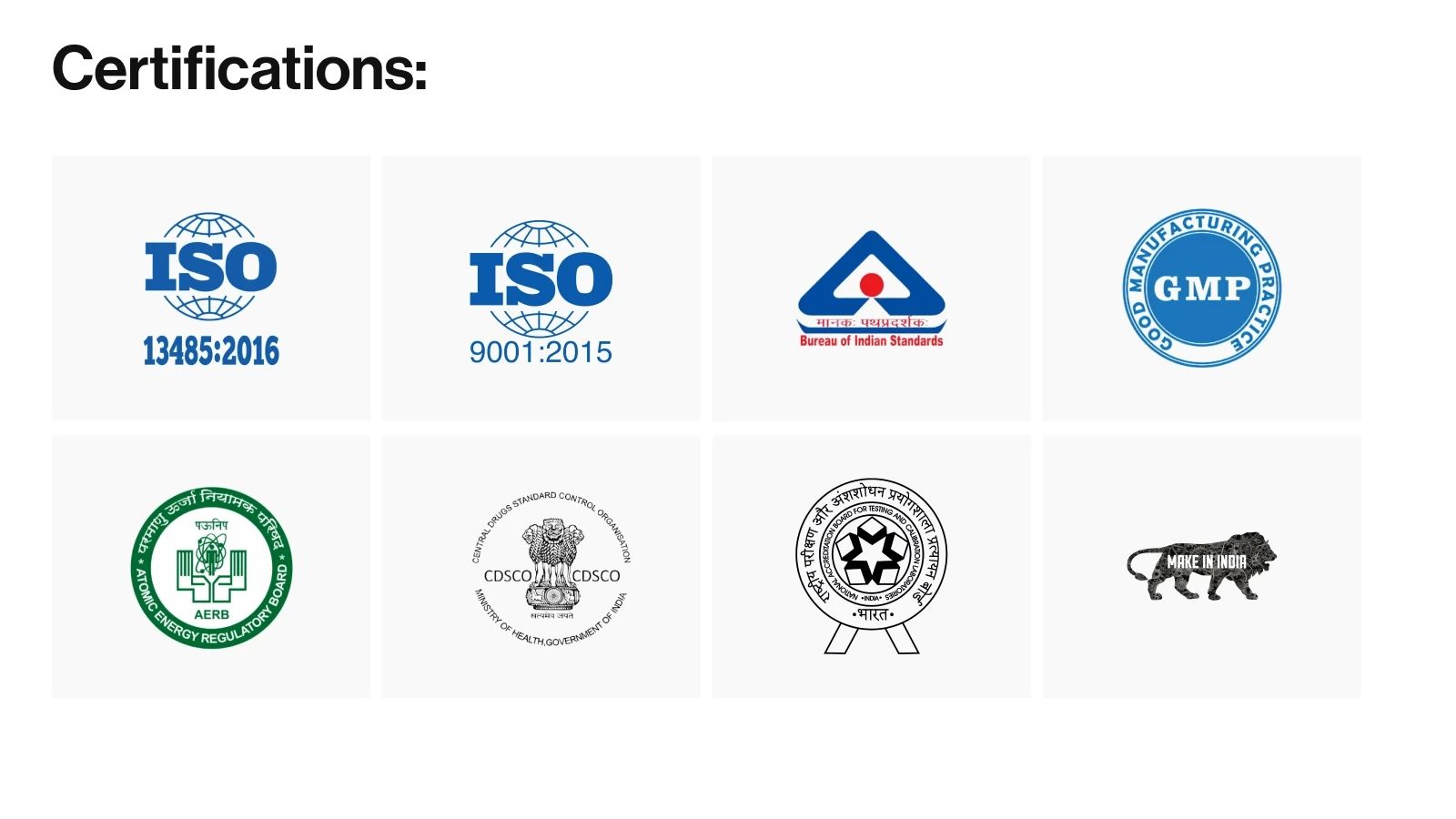
Hospital procurement teams encounter multiple certification marks when evaluating equipment. Here's what each one covers for X-ray devices.
AERB Type Approval — Issued by the Atomic Energy Regulatory Board, India. Mandatory for India. Covers radiation safety, electrical safety, and beam quality for legal use in India.
CE Mark — Issued by European conformity bodies. Not mandatory for India. Covers European safety standards — required for the EU market, not India.
FDA 510(k) — Issued by the US Food and Drug Administration. Not mandatory for India. Covers US market clearance — not valid for India on its own.
ISO 13485:2016 — Issued by ISO via accredited certifiers. Not mandatory, but significant. Covers the quality management system used in medical device manufacturing.
NABL Accreditation — Issued by the National Accreditation Board for Testing. Not mandatory. Covers accreditation of the testing laboratory used for QA.
BIS Certification — Issued by the Bureau of Indian Standards. Depends on the product. Covers conformity to Indian national standards.
GMP Certification — Issued by the Drug Controller General of India. Not mandatory. Covers Good Manufacturing Practice compliance.
For use in India, AERB is the baseline. ISO 13485 tells you how the manufacturer runs their quality system. NABL tells you about their testing methodology. CE and FDA are useful additional signals — they indicate the product has passed scrutiny in other jurisdictions, but they don't replace AERB.
A Note on Imported X-Ray Equipment
This is worth stating plainly because it causes confusion in procurement: foreign regulatory clearance does not replace AERB.
A portable X-ray system that is FDA-cleared and routinely used in US hospitals still needs to go through AERB's evaluation before it can be operated in India. The same is true for CE-marked systems from European manufacturers. The AERB process is not automatic or assumed on the basis of overseas approvals, it has to be completed for each device model separately.
This has a practical cost implication. An imported system that hasn't yet obtained AERB approval can't be deployed on arrival. If procurement teams don't verify this before placing an order, the "cheaper" imported option can carry hidden costs: delays in deployment, additional compliance fees, or discovered during audit, the cost of replacing non-compliant equipment entirely.
Local manufacturers who have already completed the AERB process eliminate this risk at the point of purchase.
What Certifications Humanic India's Systems Carry
All Humanic portable X-ray systems the RX 90, RX 370, RX 590, RX 706, and RX 910, carry AERB type approval. The devices are manufactured in India and tested under NABL-accredited conditions. The company also holds ISO 13485:2016, ISO 9001:2015, GMP, and BIS certifications across its product range.
In practical terms, this means the compliance documentation you need for a tender submission or hospital accreditation audit, including AERB certificate copies, is supplied as standard with every purchase. You don't need to chase it separately or wait for it after delivery.
If you're evaluating Humanic systems for a government programme, hospital procurement, or field health deployment, you can request the full compliance documentation package through our contact page.
Frequently Asked Questions
Is AERB approval mandatory for portable X-ray machines?
Yes. The requirement applies to all X-ray equipment used in India, regardless of form factor. Portable systems, handheld units, and vehicle-mounted devices all require AERB type approval before they can be legally operated. There is no exemption for smaller or lower-power devices.
Does an FDA-cleared X-ray machine need AERB approval to operate in India?
Yes. FDA clearance covers the United States market. AERB approval is a separate Indian regulatory requirement. The two processes run independently, and FDA clearance does not satisfy AERB's evaluation requirements.
How do I verify that a supplier's AERB certificate is genuine?
Ask for the AERB type approval certificate number, then look it up directly on aerb.gov.in in the equipment registry. Confirm it covers the specific model being quoted and that it hasn't expired. For government tenders, request a notarised copy for the tender file.
What are the consequences of using X-ray equipment without AERB approval?
Operating non-AERB-approved equipment in India is illegal under the Atomic Energy Act. Institutions face regulatory penalties, licence suspension, and personal liability if a radiation safety incident occurs. For government institutions, there is also significant audit risk associated with the procurement decision itself.
Do Humanic portable X-ray systems have AERB approval?
Yes. All Humanic portable X-ray systems hold AERB type approval, along with ISO 13485:2016, ISO 9001:2015, GMP, and BIS certifications. Full compliance documentation — including certificate copies — is included with every purchase. You can request a documentation package in advance through our contact page.
If you're procuring X-ray equipment for a hospital, a government health programme, or a field deployment, there's one certification you need to check before anything else. Not image resolution specs. Not the price. Not whether the supplier mentions CE marking or FDA clearance.
AERB first. Everything else second.
Here's what it actually means, what it does and doesn't tell you, and how to verify it properly.
What Is AERB?
The Atomic Energy Regulatory Board is India's statutory authority for radiation-emitting equipment. It operates under the Atomic Energy Act of 1962, and can set safety standards, grant approvals, and revoke them when equipment fails to comply.
Any X-ray machine used in India, a private hospital, a government PHC, a mobile health van, or a field camp needs AERB type approval before it can be legally switched on. That applies to systems made in India and to systems imported from the US or Europe.
This is where procurement teams sometimes get tripped up: a CE mark from the EU does not substitute for AERB. Neither does FDA clearance. These are country-specific approvals for their own markets. India runs its own evaluation process independently.
What AERB Actually Evaluates
AERB's type approval process isn't a formality. The board evaluates several things that matter directly in clinical use.
Radiation output and leakage. How much radiation the tube emits, and whether it stays within safe limits during normal operation.
Beam quality and filtration. The energy spectrum of the X-ray beam affects both image quality and how much radiation the patient receives per exposure. It's not just a safety metric; it's a diagnostic one.
Exposure control and reproducibility. Whether the machine consistently delivers the set exposure or varies between shots. A device that can't reproduce its settings reliably is a clinical problem, not just a technical one.
Electrical safety. Protection against shock hazards for the operator and patient.
Mechanical stability. Whether the device holds its position during exposure without drifting or shifting.
Labelling and documentation. Whether the device carries required warning labels and comes with user documentation adequate for safe operation.
A device that passes all of this receives a type approval certificate. The certificate number can be verified on the AERB website at aerb.gov.in.
How to Verify an AERB Certificate Properly
Asking a supplier for their certificate isn't enough on its own. Certificates can be outdated, apply to a different model from the same product range, or in rare cases be presented in a misleading way. The correct process takes about 15 minutes.
Ask the supplier for their AERB type approval certificate number.
Go to aerb.gov.in and search the certificate in the equipment registry.
Confirm the certificate covers the exact model being quoted not a related or similar variant.
Check the certificate expiry date. Approvals require periodic renewal.
For government tender submissions, request a notarised copy of the certificate for your tender file.
Step 3 is the one most frequently skipped. A manufacturer may legitimately hold AERB approval for one model in a product line but quote a different model that hasn't yet completed the process. The certificate number lookup on the AERB portal will surface this immediately.
AERB vs Other Certifications — What Each One Actually Means
Hospital procurement teams encounter multiple certification marks when evaluating equipment. Here's what each one covers for X-ray devices.
AERB Type Approval — Issued by the Atomic Energy Regulatory Board, India. Mandatory for India. Covers radiation safety, electrical safety, and beam quality for legal use in India.
CE Mark — Issued by European conformity bodies. Not mandatory for India. Covers European safety standards — required for the EU market, not India.
FDA 510(k) — Issued by the US Food and Drug Administration. Not mandatory for India. Covers US market clearance — not valid for India on its own.
ISO 13485:2016 — Issued by ISO via accredited certifiers. Not mandatory, but significant. Covers the quality management system used in medical device manufacturing.
NABL Accreditation — Issued by the National Accreditation Board for Testing. Not mandatory. Covers accreditation of the testing laboratory used for QA.
BIS Certification — Issued by the Bureau of Indian Standards. Depends on the product. Covers conformity to Indian national standards.
GMP Certification — Issued by the Drug Controller General of India. Not mandatory. Covers Good Manufacturing Practice compliance.
For use in India, AERB is the baseline. ISO 13485 tells you how the manufacturer runs their quality system. NABL tells you about their testing methodology. CE and FDA are useful additional signals — they indicate the product has passed scrutiny in other jurisdictions, but they don't replace AERB.
A Note on Imported X-Ray Equipment
This is worth stating plainly because it causes confusion in procurement: foreign regulatory clearance does not replace AERB.
A portable X-ray system that is FDA-cleared and routinely used in US hospitals still needs to go through AERB's evaluation before it can be operated in India. The same is true for CE-marked systems from European manufacturers. The AERB process is not automatic or assumed on the basis of overseas approvals, it has to be completed for each device model separately.
This has a practical cost implication. An imported system that hasn't yet obtained AERB approval can't be deployed on arrival. If procurement teams don't verify this before placing an order, the "cheaper" imported option can carry hidden costs: delays in deployment, additional compliance fees, or discovered during audit, the cost of replacing non-compliant equipment entirely.
Local manufacturers who have already completed the AERB process eliminate this risk at the point of purchase.
What Certifications Humanic India's Systems Carry
All Humanic portable X-ray systems the RX 90, RX 370, RX 590, RX 706, and RX 910, carry AERB type approval. The devices are manufactured in India and tested under NABL-accredited conditions. The company also holds ISO 13485:2016, ISO 9001:2015, GMP, and BIS certifications across its product range.
In practical terms, this means the compliance documentation you need for a tender submission or hospital accreditation audit, including AERB certificate copies, is supplied as standard with every purchase. You don't need to chase it separately or wait for it after delivery.
If you're evaluating Humanic systems for a government programme, hospital procurement, or field health deployment, you can request the full compliance documentation package through our contact page.
Frequently Asked Questions
Is AERB approval mandatory for portable X-ray machines?
Yes. The requirement applies to all X-ray equipment used in India, regardless of form factor. Portable systems, handheld units, and vehicle-mounted devices all require AERB type approval before they can be legally operated. There is no exemption for smaller or lower-power devices.
Does an FDA-cleared X-ray machine need AERB approval to operate in India?
Yes. FDA clearance covers the United States market. AERB approval is a separate Indian regulatory requirement. The two processes run independently, and FDA clearance does not satisfy AERB's evaluation requirements.
How do I verify that a supplier's AERB certificate is genuine?
Ask for the AERB type approval certificate number, then look it up directly on aerb.gov.in in the equipment registry. Confirm it covers the specific model being quoted and that it hasn't expired. For government tenders, request a notarised copy for the tender file.
What are the consequences of using X-ray equipment without AERB approval?
Operating non-AERB-approved equipment in India is illegal under the Atomic Energy Act. Institutions face regulatory penalties, licence suspension, and personal liability if a radiation safety incident occurs. For government institutions, there is also significant audit risk associated with the procurement decision itself.
Do Humanic portable X-ray systems have AERB approval?
Yes. All Humanic portable X-ray systems hold AERB type approval, along with ISO 13485:2016, ISO 9001:2015, GMP, and BIS certifications. Full compliance documentation — including certificate copies — is included with every purchase. You can request a documentation package in advance through our contact page.
Get in touch for detailed information about our product and services
Get in touch for detailed information about our product and services


Address:
E-21, Ground Floor, B-1 Ext., Mohan Cooperative Industrial Estate, Mathura Road, Badarpur,
New Delhi - 110044, India
Phone
(WhatsApp):
+91-9990455744
Email:
Address:
E-21, Ground Floor, B-1 Ext.,
Mohan Cooperative Industrial Estate, Mathura Road, Badarpur,
New Delhi - 110044, India
Phone
(WhatsApp):
+91-9990455744
Email:
Address:
E-21, Ground Floor, B-1 Ext., Mohan Cooperative
Industrial Estate,
Mathura Road, Badarpur,
New Delhi - 110044, India
Phone
(WhatsApp):
+91-9990455744
Email: