Digital vs. Portable X-Ray: Which One Does Your Hospital Actually Need?
Digital vs. Portable X-Ray: Which One Does Your Hospital Actually Need?
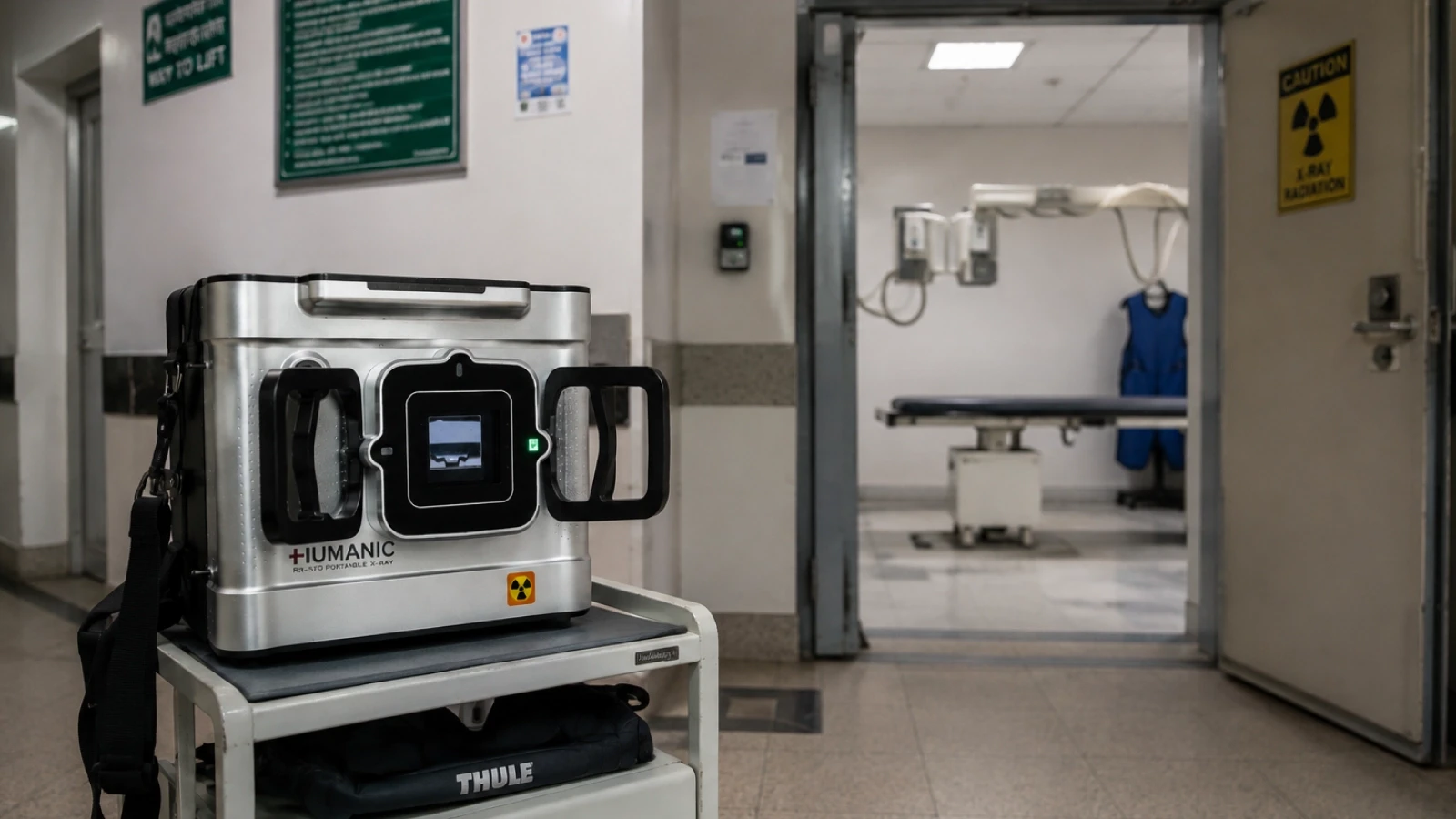
This is a common but slightly misleading framing, because "digital" and "portable" aren't opposites — most modern portable X-ray systems, including Humanic's RX series, are digital radiography (DR) systems built into a mobile form factor. The real decision hospitals face isn't digital versus portable, it's fixed digital radiography versus portable digital radiography, and the right answer depends on throughput, patient mobility, and space, not image format.
Clearing up the terminology
Term | What it actually means |
|---|---|
Digital radiography (DR) | X-ray images captured directly as digital files via a flat panel detector, no film or plate processing required |
Computed radiography (CR) | An older digital method using a cassette-based imaging plate that requires a separate reader/scanner step |
Fixed X-ray system | Installed in a dedicated, shielded room; not designed to move |
Portable X-ray system | Mobile unit that moves to the patient; can be DR or, less commonly today, CR |
Nearly all new portable systems on the market, including Humanic's, are DR — so if you're comparing a modern portable unit to a modern fixed unit, image capture technology is often equivalent. The real differences are elsewhere.
What actually differs between fixed and portable DR systems
Throughput. Fixed installations, especially with a dedicated radiographer and room, handle higher patient volume more efficiently. If your department runs 150+ studies a day, a fixed room is still the right backbone.
Patient mobility. Portable systems bring the imaging to the patient — critical for ICU, post-operative, and trauma cases where moving the patient carries real clinical risk.
Space and infrastructure. A fixed installation requires a dedicated, lead-lined room. A portable system requires only storage and charging space, which matters for hospitals with space constraints or multiple sites.
Deployment flexibility. A portable unit can move between wards or even facilities. A fixed installation is permanent by design.
Cost structure. Fixed rooms carry higher upfront construction and shielding costs (commonly ₹5-15 lakh for construction and lead lining alone in India) but lower per-study operating cost at high volume. Portable systems have lower upfront infrastructure cost but are optimized for flexibility rather than maximum throughput.
Three questions to guide the decision
What's your actual daily study volume, and is it concentrated or distributed across the facility?
High, concentrated volume favors fixed. Distributed, unpredictable demand favors portable.
How often do you need to image patients who can't be moved safely?
If this is a regular occurrence — ICU, post-op, isolation — portable capability isn't optional.
Do you have the space and budget for a dedicated shielded room, or do you need imaging capability now with lower upfront infrastructure cost?
Most hospitals of meaningful size end up needing both — a fixed installation as the throughput backbone, and one or more portable units for bedside, emergency, and overflow imaging. The question usually isn't "which one" but "in what ratio."
Frequently Asked Questions
Is portable X-ray image quality lower than fixed digital X-ray?
Not inherently — both typically use digital radiography (DR) technology today, so image quality is primarily a function of the detector panel and generator, not whether the unit is portable or fixed.
Can a portable X-ray system fully replace a fixed radiology room?
For high-volume departments, generally no — fixed systems remain more efficient at scale. Portable systems are best deployed alongside a fixed installation, not as a full replacement, in most hospital settings.
Is CR (computed radiography) the same as portable X-ray?
No. CR refers to an older image-capture method using cassette plates; it's separate from whether a unit is portable or fixed. Most modern portable systems today use DR, not CR.
How much does a fixed radiology room cost to build compared to buying a portable system?
Fixed room construction and lead lining in India commonly runs ₹5-15 lakh before equipment cost; portable systems avoid this infrastructure cost but are designed for flexibility rather than maximum throughput.
This is a common but slightly misleading framing, because "digital" and "portable" aren't opposites — most modern portable X-ray systems, including Humanic's RX series, are digital radiography (DR) systems built into a mobile form factor. The real decision hospitals face isn't digital versus portable, it's fixed digital radiography versus portable digital radiography, and the right answer depends on throughput, patient mobility, and space, not image format.
Clearing up the terminology
Term | What it actually means |
|---|---|
Digital radiography (DR) | X-ray images captured directly as digital files via a flat panel detector, no film or plate processing required |
Computed radiography (CR) | An older digital method using a cassette-based imaging plate that requires a separate reader/scanner step |
Fixed X-ray system | Installed in a dedicated, shielded room; not designed to move |
Portable X-ray system | Mobile unit that moves to the patient; can be DR or, less commonly today, CR |
Nearly all new portable systems on the market, including Humanic's, are DR — so if you're comparing a modern portable unit to a modern fixed unit, image capture technology is often equivalent. The real differences are elsewhere.
What actually differs between fixed and portable DR systems
Throughput. Fixed installations, especially with a dedicated radiographer and room, handle higher patient volume more efficiently. If your department runs 150+ studies a day, a fixed room is still the right backbone.
Patient mobility. Portable systems bring the imaging to the patient — critical for ICU, post-operative, and trauma cases where moving the patient carries real clinical risk.
Space and infrastructure. A fixed installation requires a dedicated, lead-lined room. A portable system requires only storage and charging space, which matters for hospitals with space constraints or multiple sites.
Deployment flexibility. A portable unit can move between wards or even facilities. A fixed installation is permanent by design.
Cost structure. Fixed rooms carry higher upfront construction and shielding costs (commonly ₹5-15 lakh for construction and lead lining alone in India) but lower per-study operating cost at high volume. Portable systems have lower upfront infrastructure cost but are optimized for flexibility rather than maximum throughput.
Three questions to guide the decision
What's your actual daily study volume, and is it concentrated or distributed across the facility?
High, concentrated volume favors fixed. Distributed, unpredictable demand favors portable.
How often do you need to image patients who can't be moved safely?
If this is a regular occurrence — ICU, post-op, isolation — portable capability isn't optional.
Do you have the space and budget for a dedicated shielded room, or do you need imaging capability now with lower upfront infrastructure cost?
Most hospitals of meaningful size end up needing both — a fixed installation as the throughput backbone, and one or more portable units for bedside, emergency, and overflow imaging. The question usually isn't "which one" but "in what ratio."
Frequently Asked Questions
Is portable X-ray image quality lower than fixed digital X-ray?
Not inherently — both typically use digital radiography (DR) technology today, so image quality is primarily a function of the detector panel and generator, not whether the unit is portable or fixed.
Can a portable X-ray system fully replace a fixed radiology room?
For high-volume departments, generally no — fixed systems remain more efficient at scale. Portable systems are best deployed alongside a fixed installation, not as a full replacement, in most hospital settings.
Is CR (computed radiography) the same as portable X-ray?
No. CR refers to an older image-capture method using cassette plates; it's separate from whether a unit is portable or fixed. Most modern portable systems today use DR, not CR.
How much does a fixed radiology room cost to build compared to buying a portable system?
Fixed room construction and lead lining in India commonly runs ₹5-15 lakh before equipment cost; portable systems avoid this infrastructure cost but are designed for flexibility rather than maximum throughput.
Get in touch for detailed information about our product and services
Get in touch for detailed information about our product and services


Address:
E-21, Ground Floor, B-1 Ext., Mohan Cooperative Industrial Estate, Mathura Road, Badarpur,
New Delhi - 110044, India
Phone
(WhatsApp):
+91-9990455744
Email:
Address:
E-21, Ground Floor, B-1 Ext.,
Mohan Cooperative Industrial Estate, Mathura Road, Badarpur,
New Delhi - 110044, India
Phone
(WhatsApp):
+91-9990455744
Email:
Address:
E-21, Ground Floor, B-1 Ext., Mohan Cooperative
Industrial Estate,
Mathura Road, Badarpur,
New Delhi - 110044, India
Phone
(WhatsApp):
+91-9990455744
Email: