X-Ray Machine for Ambulances (A Complete Buying Guide)
X-Ray Machine for Ambulances (A Complete Buying Guide)
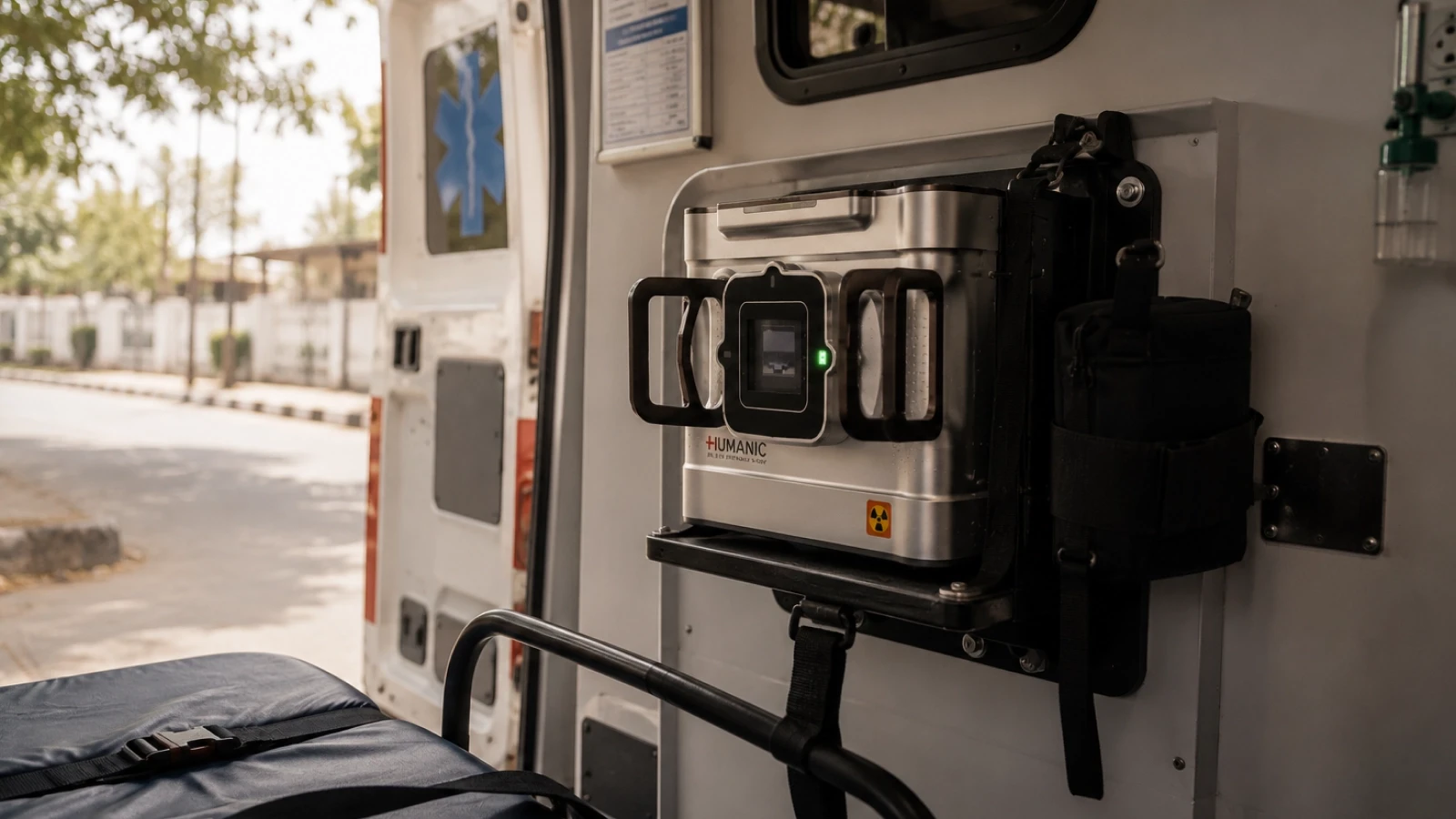
Equipping an ambulance or emergency response vehicle with X-ray capability lets trauma and emergency teams get diagnostic imaging started before a patient reaches a fixed radiology department, a meaningful advantage in trauma cases where minutes matter. But an ambulance is a fundamentally different deployment environment than a hospital ward or mobile health van, and the buying criteria shift accordingly.
What's different about an ambulance deployment
A unit designed for a mobile health van sits in a relatively stable, purpose-built vehicle interior. An ambulance-mounted system has to handle sudden braking and acceleration, tighter space constraints, a moving patient, and a team working under time pressure all while maintaining radiation safety for both the patient and the crew in a confined space.
What to check before equipping an ambulance
Mounting and securing. The unit needs a mounting solution rated for vehicle motion, not just a wheeled cart that happens to fit in the back. Confirm the mounting hardware is designed for the specific vehicle class you're deploying in.
Weight and one-person handling. In an ambulance, the operator is frequently working alone or with one assistant under time pressure. A unit under 3.2 kg that one person can position quickly matters more here than in a hospital setting where more hands are typically available.
Radiation safety in a confined space. Ambulance interiors are smaller than a shielded radiology room. Confirm the unit's exposure characteristics and required safe-distance parameters are appropriate for the actual cabin space, and that crew positioning protocols are built into training.
Power reliability. The unit needs to function reliably regardless of the vehicle's engine state or electrical system this is a scenario where a well-engineered battery system, rather than a vehicle power draw, is usually the safer design choice.
IP rating. Ambulances see more vibration, temperature swings, and incidental exposure to fluids than a hospital ward. Confirm the unit's IP rating is appropriate for that environment.
AERB registration for the specific deployment. Mobile and vehicle-mounted X-ray deployments have their own registration considerations distinct from a fixed installation confirm this is addressed as part of your compliance documentation before deployment, not after.
Training considerations specific to emergency crews
Emergency and trauma teams are already managing a high-pressure environment. Operator training for an ambulance-mounted system should be built around speed and muscle memory positioning, exposure, and stowing the unit safely rather than a generic radiography training module. Confirm this is part of what your supplier's service and training package actually covers.
Frequently Asked Questions
Can any portable X-ray machine be mounted in an ambulance?
Not safely. Ambulance deployment requires vehicle-rated mounting hardware and a unit designed to maintain performance and safety under vehicle motion confirm this specifically rather than assuming a general-purpose portable unit is suitable as-is.
Does an ambulance-mounted X-ray machine need separate AERB registration?
Mobile and vehicle-mounted deployments have their own registration considerations. Confirm the specific requirements for your deployment with AERB or your compliance documentation provider before installation.
How is radiation safety managed in the confined space of an ambulance?
Through a combination of the unit's exposure characteristics, defined crew safe-distance protocols, and training built specifically around the vehicle's actual interior space this should be confirmed with your supplier before deployment, not assumed from general radiography guidelines.
What weight is manageable for one-person ambulance operation?
Under 3.2 kg is a reasonable benchmark for genuinely one-person-portable handling under time pressure, though the right answer also depends on your crew's specific operating procedures.
Equipping an ambulance or emergency response vehicle with X-ray capability lets trauma and emergency teams get diagnostic imaging started before a patient reaches a fixed radiology department, a meaningful advantage in trauma cases where minutes matter. But an ambulance is a fundamentally different deployment environment than a hospital ward or mobile health van, and the buying criteria shift accordingly.
What's different about an ambulance deployment
A unit designed for a mobile health van sits in a relatively stable, purpose-built vehicle interior. An ambulance-mounted system has to handle sudden braking and acceleration, tighter space constraints, a moving patient, and a team working under time pressure all while maintaining radiation safety for both the patient and the crew in a confined space.
What to check before equipping an ambulance
Mounting and securing. The unit needs a mounting solution rated for vehicle motion, not just a wheeled cart that happens to fit in the back. Confirm the mounting hardware is designed for the specific vehicle class you're deploying in.
Weight and one-person handling. In an ambulance, the operator is frequently working alone or with one assistant under time pressure. A unit under 3.2 kg that one person can position quickly matters more here than in a hospital setting where more hands are typically available.
Radiation safety in a confined space. Ambulance interiors are smaller than a shielded radiology room. Confirm the unit's exposure characteristics and required safe-distance parameters are appropriate for the actual cabin space, and that crew positioning protocols are built into training.
Power reliability. The unit needs to function reliably regardless of the vehicle's engine state or electrical system this is a scenario where a well-engineered battery system, rather than a vehicle power draw, is usually the safer design choice.
IP rating. Ambulances see more vibration, temperature swings, and incidental exposure to fluids than a hospital ward. Confirm the unit's IP rating is appropriate for that environment.
AERB registration for the specific deployment. Mobile and vehicle-mounted X-ray deployments have their own registration considerations distinct from a fixed installation confirm this is addressed as part of your compliance documentation before deployment, not after.
Training considerations specific to emergency crews
Emergency and trauma teams are already managing a high-pressure environment. Operator training for an ambulance-mounted system should be built around speed and muscle memory positioning, exposure, and stowing the unit safely rather than a generic radiography training module. Confirm this is part of what your supplier's service and training package actually covers.
Frequently Asked Questions
Can any portable X-ray machine be mounted in an ambulance?
Not safely. Ambulance deployment requires vehicle-rated mounting hardware and a unit designed to maintain performance and safety under vehicle motion confirm this specifically rather than assuming a general-purpose portable unit is suitable as-is.
Does an ambulance-mounted X-ray machine need separate AERB registration?
Mobile and vehicle-mounted deployments have their own registration considerations. Confirm the specific requirements for your deployment with AERB or your compliance documentation provider before installation.
How is radiation safety managed in the confined space of an ambulance?
Through a combination of the unit's exposure characteristics, defined crew safe-distance protocols, and training built specifically around the vehicle's actual interior space this should be confirmed with your supplier before deployment, not assumed from general radiography guidelines.
What weight is manageable for one-person ambulance operation?
Under 3.2 kg is a reasonable benchmark for genuinely one-person-portable handling under time pressure, though the right answer also depends on your crew's specific operating procedures.
Get in touch for detailed information about our product and services
Get in touch for detailed information about our product and services


Address:
E-21, Ground Floor, B-1 Ext., Mohan Cooperative Industrial Estate, Mathura Road, Badarpur,
New Delhi - 110044, India
Phone
(WhatsApp):
+91-9990455744
Email:
Address:
E-21, Ground Floor, B-1 Ext.,
Mohan Cooperative Industrial Estate, Mathura Road, Badarpur,
New Delhi - 110044, India
Phone
(WhatsApp):
+91-9990455744
Email:
Address:
E-21, Ground Floor, B-1 Ext., Mohan Cooperative
Industrial Estate,
Mathura Road, Badarpur,
New Delhi - 110044, India
Phone
(WhatsApp):
+91-9990455744
Email: