Portable vs fixed X-ray: when does a mobile system make sense?
Portable vs fixed X-ray: when does a mobile system make sense?
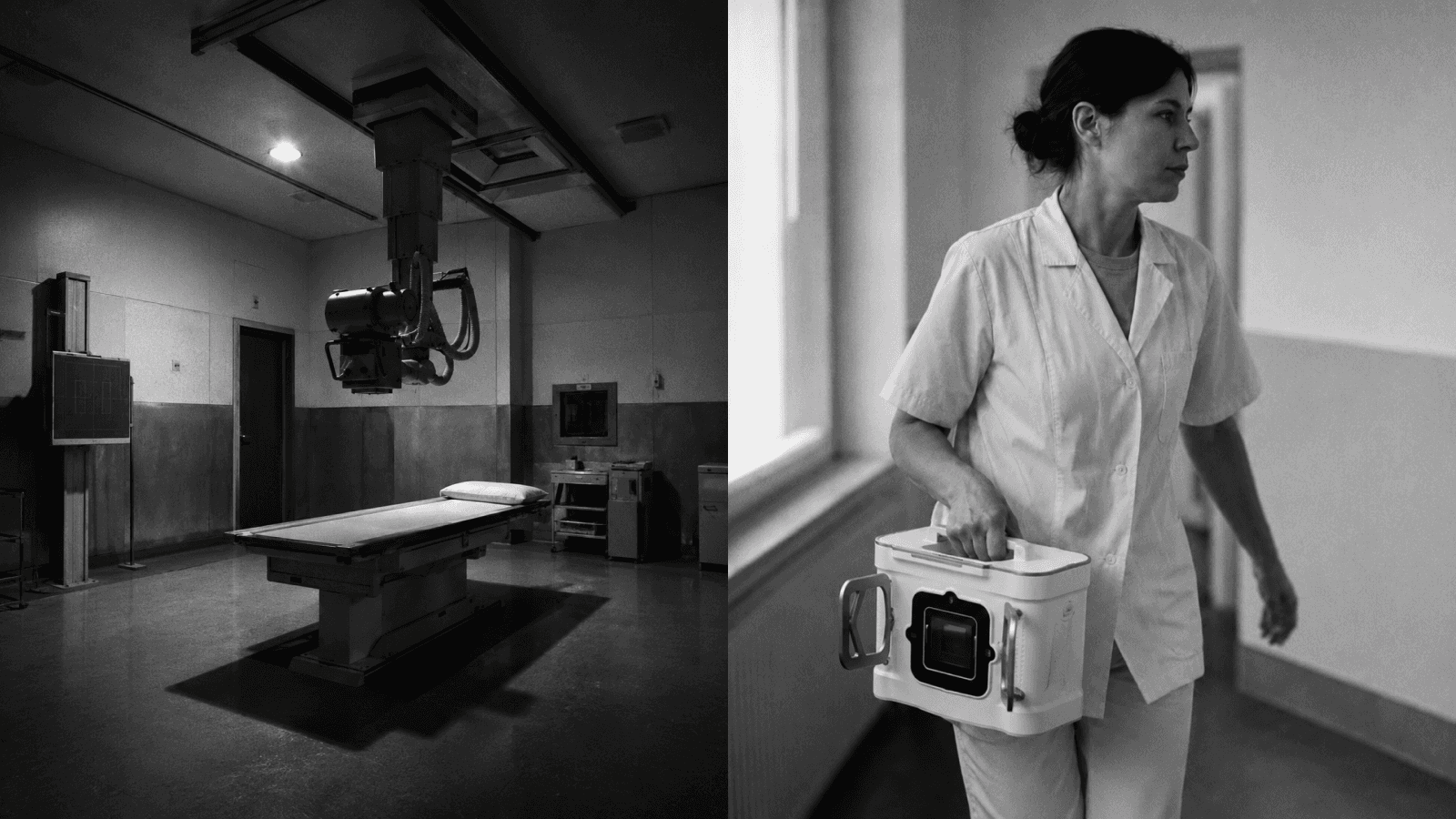
Here’s how this question usually comes up. A trauma team needs chest imaging on a patient in the resuscitation bay who cannot be moved to radiology. A state health department is equipping 40 primary health centres, none of which have a shielded room. An NGO’s mobile unit runs diagnostic camps in villages with no mains power for 60 kilometres in any direction.
By the time procurement teams are seriously comparing portable and fixed X-ray systems, there’s a specific constraint behind the search. That constraint is the most useful starting point because the right answer looks entirely different depending on it.
This isn’t a case for one technology over the other. Both have real applications. What follows is a straightforward breakdown of where each performs, where it falls short, and how to decide for your setting.
The core technical difference
A fixed X-ray system is installed in a lead-lined radiology room. It runs on mains power, stays in one location, and handles high daily throughput for a standard radiology department. For a busy urban hospital running 150 or more studies per day, that’s the right setup. The infrastructure cost is substantial, but so is the output.
A portable system weighs a few kilograms, runs on a rechargeable battery, and goes where the clinical team goes. Modern portable systems produce diagnostic-quality images for a defined range of studies. They don’t replace a high-volume fixed department. What they replace is the need to transport patients who shouldn’t be moved, or to build permanent imaging infrastructure in environments where that isn’t feasible.
Where fixed systems are still the right choice Worth saying plainly.
The portable case is stronger than most procurement teams initially expect.
ICU and high-dependency units
Moving a ventilated or post-surgical patient to radiology introduces clinical risk. Portable bedside X-ray removes that risk. Line placement confirmation, post-operative monitoring, respiratory assessment these studies happen at the bedside. A portable system goes to the patient; a fixed system requires the patient to come to it.
Emergency and trauma
A chest X-ray on a trauma patient in the resuscitation bay can’t wait for transport logistics. Portable imaging in the emergency department shortens the gap between patient arrival and clinical decision.
Rural primary health centres
PHCs typically lack a shielded radiology room, reliable mains power, and permanent radiology staff. A fixed X-ray system requires all three. A portable, battery-operated system requires none of them. Chest imaging, fracture assessment, and abdominal studies these account for most PHC imaging volume, and portable systems handle them without the infrastructure burden.
Government field programmes
NHM screening camps, TB detection drives, and district health outreach operate in locations that have no imaging infrastructure at all. There’s no practical version of a fixed X-ray system for these applications. A portable system is the only tool that works operationally.
Defence medical corps
In field deployments where evacuation to a base medical facility can take many hours, on-site imaging determines triage priority. Portable systems are standard medical equipment in military field operations for exactly this reason.
Multi-site operations
One portable device covering multiple wards, satellite clinics, or rotating field sites changes the economics significantly. A fixed system’s value is tied to one location. A portable system’s value scales with how many locations it can serve.
The pattern is consistent across all of these. Either the patient cannot reach a fixed room, or there is no fixed room to reach.
What modern portable X-ray can and cannot do
There’s a persistent assumption that portable means compromised image quality. That was accurate for older technology. For current-generation systems, it isn’t.
Modern portable X-ray systems produce diagnostic-quality images for chest, abdomen, pelvis, spine, and extremity studies. [AERB-approved]
portable systems like Humanic’s range undergo the same type approval testing as fixed equipment. The images are suitable for clinical decision-making in the applications these devices are designed for.
What they don’t do well: very high daily throughput from one location, studies requiring very large detector formats, and fluoroscopy. Those stay in fixed-system territory.
A useful framing for rural health centres and mobile units: the studies that account for most of their imaging volume chest, pelvis, extremities are well within portable capability. The rare complex study that falls outside that range is a patient who needs referral to a tertiary centre regardless. Portable imaging at the primary level identifies who those patients are.
What to check before procuring a portable system
Once the decision points toward portable, these specifics matter.
Battery capacity. How many exposures per charge? For field use, you need a device that runs a full working day without recharging. Humanic systems deliver 150-plus exposures per charge.
Image sensor type. Digital radiography (DR) panels produce results faster than computed radiography (CR) systems and don’t require cassette handling. For field deployments where speed matters, DR is worth specifying.
Weight and carry design. For mobile health vans and outreach programmes, these affect daily usability more than any specification on paper.
Service network in India. Imported devices often have limited in-country service coverage. How quickly can a faulty component be replaced in your region? For government deployments, this is often the deciding factor.
AERB type approval documentation. All X-ray equipment used in India requires AERB type approval, including portable systems. Request the certificate before purchase, not after. Read the AERB approval guide →
The cost comparison for India
A fixed X-ray installation includes the equipment itself, a shielded room (typically ₹5–15 lakhs for construction and lead lining depending on location and specifications), installation costs, and a permanent space commitment at one site.
A portable system has none of those requirements. No room construction, no mains dependency, no fixed footprint.
Over a five-year operating period equipment cost, servicing, spare parts, and infrastructure portable systems consistently work out ahead for facilities running fewer than 50–60 studies per day, or for any deployment that spans multiple sites. That covers most PHCs, district hospitals with moderate volumes, and all government field programmes.
For a procurement exercise covering 30 or 40 PHCs across a state, the portable option doesn’t just cost less. It’s the only model that scales to what the programme actually requires.
Three questions to guide your decision
If you’re evaluating both options for a specific facility or programme, these three questions do most of the work.
Do you need to image patients who cannot be safely transported — ICU, trauma, post-surgical recovery?
Does your deployment setting lack a shielded room or reliable mains power?
Does one device need to serve multiple wards, sites, or field locations?
One yes points toward portable. Two or three, and the fixed system case becomes difficult to justify for that particular use case.
Frequently asked questions
Can a portable X-ray machine produce diagnostic-quality images? Yes. Current-generation portable systems produce diagnostic-quality images for chest, abdomen, pelvis, spine, and extremity studies. AERB-approved systems meet the regulatory standards for clinical use in India. The image quality is suitable for clinical decision-making in bedside, field, and rural settings. Studies requiring very large detector formats still require fixed systems.
Do portable X-ray systems require a shielded room? No. Portable systems operate without a purpose-built shielded room. Standard radiation safety practices still apply maintaining safe distances and using portable shielding screens where practical but room construction is not a requirement.
How many exposures does a portable X-ray battery support? Humanic portable X-ray systems support 150 or more exposures per charge, covering a full working day of field use or multi-ward rounds without mid-day recharging.
Are portable X-ray systems suitable for rural primary health centres in India? Yes. Rural PHCs are among the strongest use cases for portable systems. They typically lack shielded rooms, have unreliable mains power, and don’t have permanent radiology staff. Battery-operated portable systems address all three constraints directly.
Is AERB type approval required for portable X-ray systems in India? Yes. The Atomic Energy Regulatory Board mandates type approval for all X-ray equipment used in India, including portable systems. Procurement teams should request the type approval certificate as part of vendor evaluation.
About Humanic India’s portable X-ray systems
Humanic India manufactures AERB-approved, battery-operated portable X-ray systems, including the RX 90, RX 370, RX 590, RX 706, and RX 910. View all portable X-ray models →designed for clinical use in hospitals, field healthcare settings, and government health programmes. Each system is manufactured in India with service support available nationally.
If you are evaluating portable imaging for a specific deployment or government programme, speak with the Humanic team for technical specifications and compliance documentation. Contact Humanic India →
Here’s how this question usually comes up. A trauma team needs chest imaging on a patient in the resuscitation bay who cannot be moved to radiology. A state health department is equipping 40 primary health centres, none of which have a shielded room. An NGO’s mobile unit runs diagnostic camps in villages with no mains power for 60 kilometres in any direction.
By the time procurement teams are seriously comparing portable and fixed X-ray systems, there’s a specific constraint behind the search. That constraint is the most useful starting point because the right answer looks entirely different depending on it.
This isn’t a case for one technology over the other. Both have real applications. What follows is a straightforward breakdown of where each performs, where it falls short, and how to decide for your setting.
The core technical difference
A fixed X-ray system is installed in a lead-lined radiology room. It runs on mains power, stays in one location, and handles high daily throughput for a standard radiology department. For a busy urban hospital running 150 or more studies per day, that’s the right setup. The infrastructure cost is substantial, but so is the output.
A portable system weighs a few kilograms, runs on a rechargeable battery, and goes where the clinical team goes. Modern portable systems produce diagnostic-quality images for a defined range of studies. They don’t replace a high-volume fixed department. What they replace is the need to transport patients who shouldn’t be moved, or to build permanent imaging infrastructure in environments where that isn’t feasible.
Where fixed systems are still the right choice Worth saying plainly.
The portable case is stronger than most procurement teams initially expect.
ICU and high-dependency units
Moving a ventilated or post-surgical patient to radiology introduces clinical risk. Portable bedside X-ray removes that risk. Line placement confirmation, post-operative monitoring, respiratory assessment these studies happen at the bedside. A portable system goes to the patient; a fixed system requires the patient to come to it.
Emergency and trauma
A chest X-ray on a trauma patient in the resuscitation bay can’t wait for transport logistics. Portable imaging in the emergency department shortens the gap between patient arrival and clinical decision.
Rural primary health centres
PHCs typically lack a shielded radiology room, reliable mains power, and permanent radiology staff. A fixed X-ray system requires all three. A portable, battery-operated system requires none of them. Chest imaging, fracture assessment, and abdominal studies these account for most PHC imaging volume, and portable systems handle them without the infrastructure burden.
Government field programmes
NHM screening camps, TB detection drives, and district health outreach operate in locations that have no imaging infrastructure at all. There’s no practical version of a fixed X-ray system for these applications. A portable system is the only tool that works operationally.
Defence medical corps
In field deployments where evacuation to a base medical facility can take many hours, on-site imaging determines triage priority. Portable systems are standard medical equipment in military field operations for exactly this reason.
Multi-site operations
One portable device covering multiple wards, satellite clinics, or rotating field sites changes the economics significantly. A fixed system’s value is tied to one location. A portable system’s value scales with how many locations it can serve.
The pattern is consistent across all of these. Either the patient cannot reach a fixed room, or there is no fixed room to reach.
What modern portable X-ray can and cannot do
There’s a persistent assumption that portable means compromised image quality. That was accurate for older technology. For current-generation systems, it isn’t.
Modern portable X-ray systems produce diagnostic-quality images for chest, abdomen, pelvis, spine, and extremity studies. [AERB-approved]
portable systems like Humanic’s range undergo the same type approval testing as fixed equipment. The images are suitable for clinical decision-making in the applications these devices are designed for.
What they don’t do well: very high daily throughput from one location, studies requiring very large detector formats, and fluoroscopy. Those stay in fixed-system territory.
A useful framing for rural health centres and mobile units: the studies that account for most of their imaging volume chest, pelvis, extremities are well within portable capability. The rare complex study that falls outside that range is a patient who needs referral to a tertiary centre regardless. Portable imaging at the primary level identifies who those patients are.
What to check before procuring a portable system
Once the decision points toward portable, these specifics matter.
Battery capacity. How many exposures per charge? For field use, you need a device that runs a full working day without recharging. Humanic systems deliver 150-plus exposures per charge.
Image sensor type. Digital radiography (DR) panels produce results faster than computed radiography (CR) systems and don’t require cassette handling. For field deployments where speed matters, DR is worth specifying.
Weight and carry design. For mobile health vans and outreach programmes, these affect daily usability more than any specification on paper.
Service network in India. Imported devices often have limited in-country service coverage. How quickly can a faulty component be replaced in your region? For government deployments, this is often the deciding factor.
AERB type approval documentation. All X-ray equipment used in India requires AERB type approval, including portable systems. Request the certificate before purchase, not after. Read the AERB approval guide →
The cost comparison for India
A fixed X-ray installation includes the equipment itself, a shielded room (typically ₹5–15 lakhs for construction and lead lining depending on location and specifications), installation costs, and a permanent space commitment at one site.
A portable system has none of those requirements. No room construction, no mains dependency, no fixed footprint.
Over a five-year operating period equipment cost, servicing, spare parts, and infrastructure portable systems consistently work out ahead for facilities running fewer than 50–60 studies per day, or for any deployment that spans multiple sites. That covers most PHCs, district hospitals with moderate volumes, and all government field programmes.
For a procurement exercise covering 30 or 40 PHCs across a state, the portable option doesn’t just cost less. It’s the only model that scales to what the programme actually requires.
Three questions to guide your decision
If you’re evaluating both options for a specific facility or programme, these three questions do most of the work.
Do you need to image patients who cannot be safely transported — ICU, trauma, post-surgical recovery?
Does your deployment setting lack a shielded room or reliable mains power?
Does one device need to serve multiple wards, sites, or field locations?
One yes points toward portable. Two or three, and the fixed system case becomes difficult to justify for that particular use case.
Frequently asked questions
Can a portable X-ray machine produce diagnostic-quality images? Yes. Current-generation portable systems produce diagnostic-quality images for chest, abdomen, pelvis, spine, and extremity studies. AERB-approved systems meet the regulatory standards for clinical use in India. The image quality is suitable for clinical decision-making in bedside, field, and rural settings. Studies requiring very large detector formats still require fixed systems.
Do portable X-ray systems require a shielded room? No. Portable systems operate without a purpose-built shielded room. Standard radiation safety practices still apply maintaining safe distances and using portable shielding screens where practical but room construction is not a requirement.
How many exposures does a portable X-ray battery support? Humanic portable X-ray systems support 150 or more exposures per charge, covering a full working day of field use or multi-ward rounds without mid-day recharging.
Are portable X-ray systems suitable for rural primary health centres in India? Yes. Rural PHCs are among the strongest use cases for portable systems. They typically lack shielded rooms, have unreliable mains power, and don’t have permanent radiology staff. Battery-operated portable systems address all three constraints directly.
Is AERB type approval required for portable X-ray systems in India? Yes. The Atomic Energy Regulatory Board mandates type approval for all X-ray equipment used in India, including portable systems. Procurement teams should request the type approval certificate as part of vendor evaluation.
About Humanic India’s portable X-ray systems
Humanic India manufactures AERB-approved, battery-operated portable X-ray systems, including the RX 90, RX 370, RX 590, RX 706, and RX 910. View all portable X-ray models →designed for clinical use in hospitals, field healthcare settings, and government health programmes. Each system is manufactured in India with service support available nationally.
If you are evaluating portable imaging for a specific deployment or government programme, speak with the Humanic team for technical specifications and compliance documentation. Contact Humanic India →
Get in touch for detailed information about our product and services
Get in touch for detailed information about our product and services


Address:
E-21, Ground Floor, B-1 Ext., Mohan Cooperative Industrial Estate, Mathura Road, Badarpur,
New Delhi - 110044, India
Phone
(WhatsApp):
+91-9990455744
Email:
Address:
E-21, Ground Floor, B-1 Ext.,
Mohan Cooperative Industrial Estate, Mathura Road, Badarpur,
New Delhi - 110044, India
Phone
(WhatsApp):
+91-9990455744
Email:
Address:
E-21, Ground Floor, B-1 Ext., Mohan Cooperative
Industrial Estate,
Mathura Road, Badarpur,
New Delhi - 110044, India
Phone
(WhatsApp):
+91-9990455744
Email: